Becky Tyler
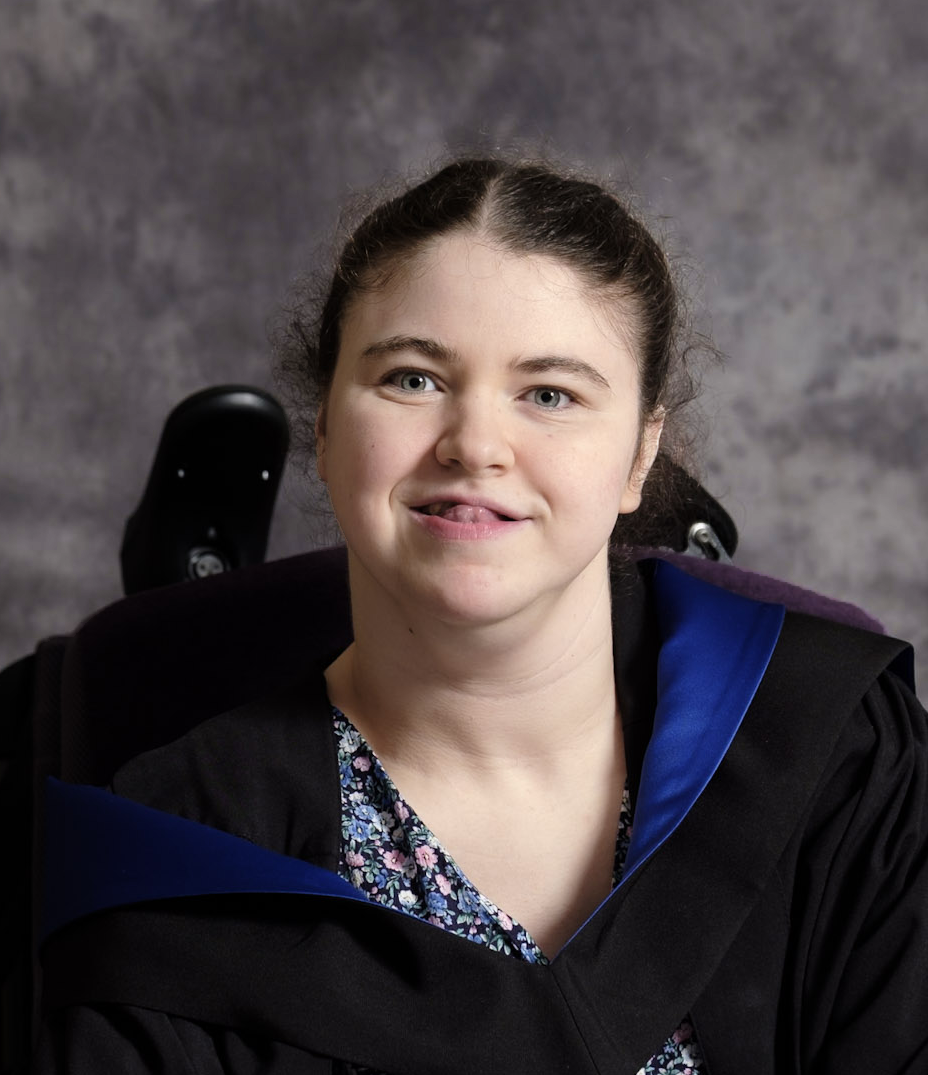
Becky is a young person with cerebral palsy and who is non-speaking. She has faced significant challenges throughout her education and as you read her story below, it will become obvious that her journey makes her a perfect ambassador for our mission to ensure that ALL children are given the opportunity to a high quality literacy education.
My name is Becky Tyler. I am a content creator, software developer, and public speaker with quadriplegic cerebral palsy. I’m determined, creative, and cheeky! I use eye gaze technology to communicate and to do my work. My disability has never stopped me achieving my goals, but the education system often tried to.
I am an ambassador for Tobii Dynavox, and I work closely with SpecialEffect, supporting the development of accessible technology like EyeMine, which enables people to play Minecraft using eye gaze. I am working on a self-employed basis. I am assisting with the AAC mentoring project at Communication Matters. I am also providing input into new software accessibility projects.
As a child, communication was a barrier. I began with yes/no flashcards, then a communication book, which opened my world and allowed me to connect with others. But while my communication improved, my education did not reflect my abilities.
Throughout my school life, I moved between mainstream and special schools. In mainstream settings, I was often isolated and not properly supported to participate. In special schools, expectations were too low, and I was not taught at the level I was capable of. When I received my first communication aid, staff were not trained to use it within lessons, and I was often left to work on my own without meaningful instruction.
By secondary school, I was working towards GCSEs and making progress. However, I was later told that exams were no longer accessible to me and that I was not “clever enough”. This was not true. My parents challenged this, but the decision stood, and I was removed from my GCSE pathway. At that point, I left school and began home education.
While being home-schooled, I was diagnosed with a genetic dyslexia, which had been completely overlooked throughout my previous educational settings. Because I use AAC, my spelling and writing were often assumed to be part of my physical disability, rather than recognised as a separate learning challenge. In reality, dyslexia can be even more challenging when you are nonverbal and rely on AAC. Every word takes time to construct, and spelling errors are far more visible and harder to correct. No one considered that I might be dyslexic, which meant I missed out on the support and teaching strategies that could have made a huge difference earlier on.
Everything changed when my education was adapted at home to meet my needs.
With the right teaching methods and full integration of my AAC technology, I made rapid progress. I achieved a range of qualifications including Grade 8 in GCSE Art. Then I went on to study Applied Computing at the University of Dundee, graduating with a Certificate of Higher Education.
My experience shows that it was not my disability that held me back, but it was other people’s perceptions and assumptions about me, and access to appropriate teaching methodologies and supports.
Today, I use my platform to advocate for change. I speak about the importance of proper AAC support in education, dyslexia as an AAC user, high expectations and the right for disabled students to access the same opportunities as their peers.
Every child deserves to be taught, believed in, and given the tools to succeed.